
Week 7
- dcm0062
- Sep 28, 2021
- 3 min read
Sauté and Pork
Method of Cookery
This week we will be using a dry cooking method; sautéing, which is a quick method of cookery. This can be done utilizing a sauté pan or frying pan. For the potatoes we will be boiling them to cook them too perfection. Lastly, for the green beans I will boil them and finish them off with seasoning.
Menu
Escalope de Porc à la Normande (Pork Escalope with apples)
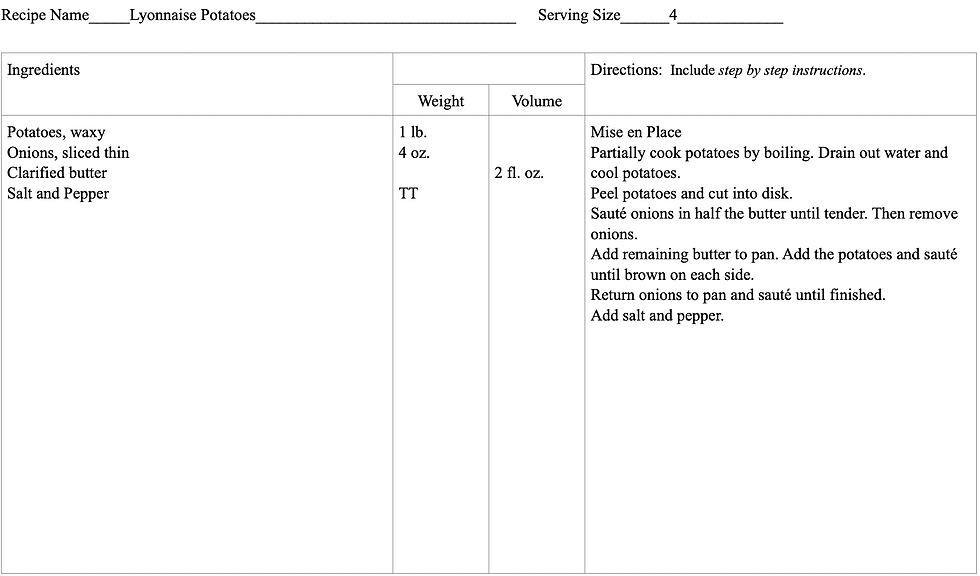
Lyonnaise Potato
Green Beans
Prior Knowledge
Going into this week I am excited because I have never cooked pork escalope but I have great prior knowledge on cooking green beans and Lyonnaise Potatoes. It's going to be a good time cooking two things I have cooked in the past but also being challenged by the pork escalope.
Learning Objectives
Identify the structure and composition of poultry.
Prepare pork for cooking - sauté
Prepare Lyonnaise Potato
Make a vinaigrette
Method of Cooking
Pork Escalope
In this weeks lab we will be sautéing in a fry pan or sauté pan pork scallops. Then I will sauté the apples in the same pan until they are tender but not brown. Lastly, I will create a sauce until it reaches nappe(Allows food to be coated evenly; hollandaise) consistency, then add in the pork scallops and let them get happy.
Lyonnaise Potato
We will start the potatoes by boiling them to perfection. Once the potatoes are cooked I will take them out and begin sautéing unions. After this I will sauté the potatoes then add the unions in for a final sauté.
Green Beans
For the green beans I will boil them first under tender then will add them to a sauté pan and throw bacon, garlic, and seasoning to finish it off. Going to be amazing.
Research
Origin and History
Pork Escalope
The word escalope originated from the French language is means a style of cooking technique. Escalope was taken off the infamous schnitzel recipe but is slightly different. Escalope first arose in French cookbooks in the 1600s. It is believed to have originated in Northern France with veal but since then pork and chicken have become common favorites of this technique.
Lyonnaise Potato
This dish originated in France around 1845 in the city of Lyon which is in the Rhone-apes region of France. The word lyonnaise comes a la lyonnaise which means containing unions. As well lyonnaise means from Lyon; the city of Lyon.
Green Beans
Green beans are believed to have originated in Peru in South America. They spread rapidly through South America through Indian tribes. Throughout history green beans have been transformed into a stable dish in many cultures around the world.
Variations
Pork Escalope
The variations of pork escalope are rather small since the process of escalope is so detailed and refined. Still, there are many ways you can transform this recipe by adding in different seasonings and creating different types of sauces for the dish.
Lyonnaise Potato
Similar to pork escalope lyonnaise potatoes recipes are similar since it is such a specific recipe. The biggest difference in recipes comes from the method of cooking the potatoes. This dish allows for multiple ways to cook the potatoes such as boil, bake, or steam. Of course, adding different seasonings can change the dish the biggest difference comes with the potatoes.
Green Beans
The variations of green beans is up for grabs, there is no right way to cook or season green beans. Throughout my life I feel like I had a thousand different variations of green beans.
Recipes


Plan of Work

Plate Representation


Citations
Chocolate, W., Says, C., Says, C., Says, A., Food, & Says, C. (2014, November 29). Lyonnaise potatoes. Retrieved September 28, 2021, from https://canapesandchocolate.com/2012/11/05/lyonnaise-potatoes/
Green beans - university of arizona. (n.d.). Retrieved September 28, 2021, from https://cals.arizona.edu/fps/sites/cals.arizona.edu.fps/files/cotw/Green_Beans.pdf
Harkins, D. (n.d.). What is a veal escalope? Retrieved September 28, 2021, from https://www.delightedcooking.com/what-is-a-veal-escalope.htm
Labensky, S. R., Martel, P. A., & Hause, A. M. (406). On Cooking: A Textbook of Culinary Fundamentals, 6/e. Retrieved from https://platform.virdocs.com/r/s/0/doc/395669/sp/17708049/mi/59019887?cfi=%2F4%2F2%5BP700101507800000000000000000616B%5D%2F18%5BP70010150780000000000000000062C3%5D%2F8%5BP70010150780000000000000000062EF%5D
Labensky, S. R., Martel, P. A., & Hause, A. M. (660). On Cooking: A Textbook of Culinary Fundamentals, 6/e. Retrieved from https://platform.virdocs.com/r/s/0/doc/395669/sp/17708049/mi/59019887?cfi=%2F4%2F2%5BP700101507800000000000000000616B%5D%2F18%5BP70010150780000000000000000062C3%5D%2F8%5BP70010150780000000000000000062EF%5D


Comments