
Week 5 Review
- dcm0062
- Sep 20, 2021
- 7 min read
Roast Chicken, Steamed Asparagus, Garlic Mashed Potato, and Supreme Sauce
Results
Throughout our time in the lab I feel like we as a group did a great job. Everything ran smoothly, we worked good as a team, and the food turned out amazing. I was expecting this outcome because I was very familiarly with all the dishes techniques and procedures.
Did the cooking technique work or not?
For the most part the cooking techniques worked great, the instructions were clear and easy to follow. The greatest success I believe we had was putting the garlic butter underneath the chickens skin. We obtained a great covering of most the chicken which is what made the skin so crunchy and moist after cooking. Another technique that worked great was mashing the potatoes. I have never before used a potato ricer but man, that things is sweet. In the past I have used a potato masher which is awesome but that potato ricer is in a whole different league. The only technique I could think of that didn't work for us was with the supreme sauce. For some reason the supreme sauce was terrible. It had a graining texture which was due to our technique when putting the flour in, furthermore, we added too much. I wish I could go back and make a better supreme sauce but, we will save it for a rainy day.
Texture
Roasted Chicken
The roasted chicken had a tremendous texture. The chicken was moist, soft, and crunchy. The meat of the chicken had a great balance between flaky and firm which was caused by the moistness of the chicken.
Asparagus
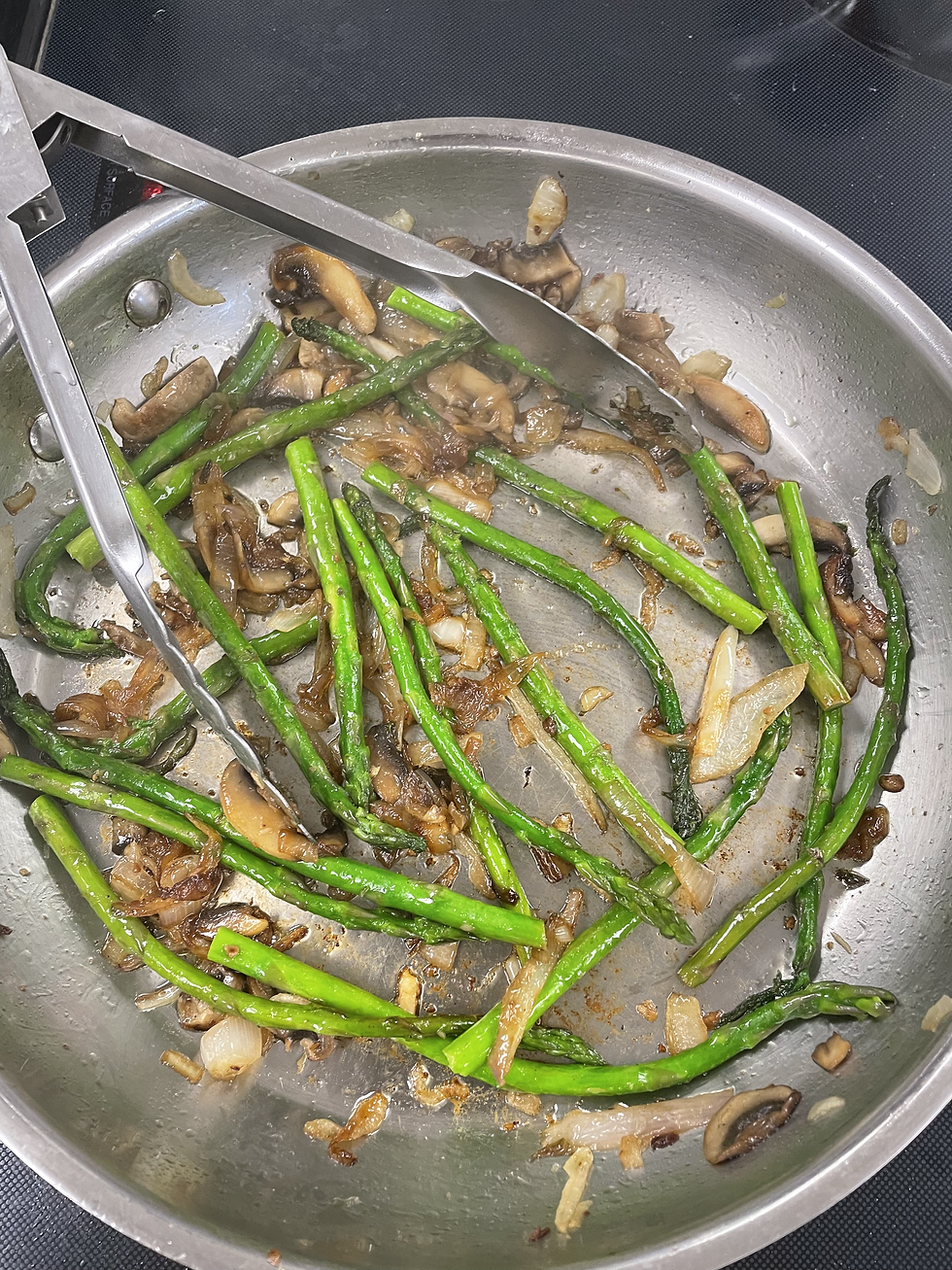
We sautéed and then steamed our asparagus which can it a nice outside crunch but with a soft middle.
Garlic Mashed Potatoes
Our potatoes were extremely soft and fluffy. When finished they looked like a cloud in the sky. They had a great median between too thick and too thin; we hit the goldy lock zone.
Supreme Sauce
The texture of our supreme sauce was terrible. It was gritting as could be, it almost tasted like someone put sand in it and the sauce was also too thick. It was just an all around disaster.
Taste
Roasted Chicken
The taste of the chicken was wonderful. It had that iconic taste that contributed a delicate but wholesome feel when eaten. The juices from the chicken were salty but not too salty. My favorite taste with this dish was the garlic. The garlic gave off that pop you look for when using it. That strong aroma and taste was awesome.
Asparagus
For our asparagus we got creative. The union we added created a great sweet taste that complimented the dish very well. The mushrooms added that earthy, wholesome, and sweet taste. Once again that garlic produced a warm and spiciness taste. Of course, you can't forget about the asparagus. It added an earthly, cleansing, and that slight bitterness.
Garlic Mashed Potatoes
The potatoes added a filling, semi-sweet, and starchy taste. They really gave me that feeling of a great potato. The garlic added so much taste to the dish, like I previously said it produced a warm and spiciness taste.
Supreme Sauce
The only taste I will received from the supreme sauce was salt and the stock used. I believe this is so because we messed it up pretty good. But, to me I could only taste them. The chicken stock gave off that cleansing and chickening taste you would expect. The salt, of course added that savory, bitter, taste.
Flavor
Roasted Chicken
The roasted chicken had a great flavor that was caused from a great conjunction of the chicken and garlic butter. The garlic butter gave the chicken skin that crunchy and juicing skin that produced an amazing savory flavor. This mixed with the moist and delicious meat created a one way trip to flavor town.
Asparagus
The asparagus, unions, garlic, and mushrooms created a flavor that was sweet, earthy, bitter, and spicy. But non of the taste over powered one another so they created a great mixture that I was super pleased with.
Garlic Mashed Potatoes
The garlic mashed potatoes were splendid. The starch from the potatoes and the garlic butte mixed beautifully. The potatoes battled the garlic to allow the garlic to not over power the dish. But, the the flavor of the garlic butter was still present.
Supreme Sauce
The flavor of this was terrible which I believe was our fault. The supreme sauce only flavor profile was salt and chicken stock but a thicker, grosser version.
Appearance


Evaluation
Why did certain techniques work or not work?
What Worked
One technique that I found was very beneficial was the method of tying up the chicken prior to cooking. The way we tied up the chicken allowed for even cooking. I know this because when I was cooking I would check the temperature to see if it was finished. Most the times I checked, it wasn't finished but, every part of the chicken was 5 degree within each other. So, the technique I used was extremely beneficial. Another technique that worked great was sautéing the asparagus then finishing them off by steaming. This allowed the asparagus to have a firm outside with a slight char, and a soft moist inside. I liked this because only steaming asparagus doesn't give it that firm, charred outside. This was a superior upgrade. Another technique that worked great was utilizing the potato ricer for making the garlic mash potatoes. Using this tools created a much more uniform, soft, and fluffy mashed potato. Especially compared to prior times when I have used a potato masher.


What Didn't Work
The worst failure we came across was when making our supreme sauce; it was terrible. When mixing the flour into our butter sauce to make our blonde roux we added too much and added the flour too rapidly. This caused the sauce to have a gritty texture and an awful flavor. This was so bad and so far has been the biggest failure in my cooking, I couldn't believe I produced something of such poor quality.

What could/would you do to improve the outcomes?
There are only a couples way I would do to produce a better outcome. First, I would throw the supreme sauce I made and start over. Unlike this go around I will add the appropriate amount of flour and add in the flour less rapidly. Doing both of these things should make my supreme sauce actually taste good which would enhance the total dish. Secondly, I would turn the oven 25 degrees hotter. During the lab we had trouble getting the core of our chicken to the proper temperature. Although, we got it there eventually, it took way to long and held up lab time. So, by making the oven 25 degrees hotter I believe the chicken would have cooked more efficiently. As well, the chicken taking longer than expected messed up our garlic mashed potatoes. It did so because we planned on the chicken being done but it was delayed by twenty minutes so our mashed potatoes got cold which was a bummer.
Conclusion
Learning Objectives
The learning objectives I achieved the best in our lab was "Apply the principles of boiling potato to make a mashed potato" and "Acquire and apply the basic principles and techniques of common dry-heat cooking methods." Our mashed potatoes cooked perfectly which made them amazing when they were hot but, they got cold 😤. When taking them out of the boiling water they were perfect; not to firm, not too soft. This is what made our garlic mashed potatoes so good. We used dry-heat cooking to cook our chicken which turned out awesome. The chicken had a moist inside and crunchy outside skin, I couldn't have asked for a better chicken. Except for it not taking as long too cook, but you can't rush perfection.
Techniques Learned Outside of Objectives
During the lab I learned what and how to use a potato ricer instead of a potato masher and the potato ricer is awesome. Prior to this lab I had no idea such thing existed but now that I do I will only use it. It was so much easier and effective, so now I will never look back. Another technique I learned so how to properly tie up a chicken for roasting. I have roasted chicken in the past but I have never tied it up like we did in the lab and this way was so much better. The chicken cooked nearly perfectly even which is exactly what you want.
How I can Apply What I Learned
As said before I will 100% utilize the potato ricer and method of tying a roasted chicken but, the biggest thing I learned is what not to do when making a supreme sauce. I learned that adding too much flour and adding it too rapidly makes a sauce almost inedible. So, in the future I will add less flour and add the flour in slowly so I can watch the transformation more closely. A great message I will take from this is: You can't take anything out but you can add things in.
What Needs More Practice
What needs more practice is obviously making supreme sauce. Furthermore, I need to practice making a better roux. That was the root of my problem when creating supreme sauce. But, with anything practice makes perfect, so in the future I will know not to add too much flour and to add flour at a slower rate.
Citations
Harlan, J. (n.d.). Make smooth and creamy mashed potatoes with a potato ricer. Retrieved September 20, 2021, from https://www.thespruceeats.com/how-to-use-a-potato-ricer-909008
Margaret Eby Updated February 07, Eby, M., Eby, M., & 07, U. (n.d.). What's going wrong with your roux. Retrieved September 20, 2021, from https://www.myrecipes.com/how-to/roux-mistakes
Sauce supreme. (n.d.). Retrieved September 20, 2021, from https://www.emerils.com/120138/sauce-supreme
Labensky, S. R., Martel, P. A., & Hause, A. M. (224). On Cooking: A Textbook of Culinary Fundamentals, 6/e. Retrieved from https://platform.virdocs.com/r/s/0/doc/395669/sp/17707992/mi/59019648?cfi=%2F4%2F2%5BP7001015078000000000000000003545%5D%2F14%5BP7001015078000000000000000003611%5D%2F18%5BP70010150780000000000000000036A7%5D%2F8%5BP70010150780000000000000000036B1%5D%2F4
Labensky, S. R., Martel, P. A., & Hause, A. M. (429). On Cooking: A Textbook of Culinary Fundamentals, 6/e. Retrieved from https://platform.virdocs.com/r/s/0/doc/395669/sp/17707992/mi/59019648?cfi=%2F4%2F2%5BP7001015078000000000000000003545%5D%2F14%5BP7001015078000000000000000003611%5D%2F18%5BP70010150780000000000000000036A7%5D%2F8%5BP70010150780000000000000000036B1%5D%2F4


Comments