
Week 11
- dcm0062
- Oct 27, 2021
- 2 min read
Updated: Nov 2, 2021
Chicken fricassee, broccoli amandine, and rice pilaf
Menu
Chicken fricassee
Broccoli amandine
Rice pilaf
Learning Objectives
Prepare a meat product for cooking using a combination cooking method: braising
Properly prepare a pasta dish
Fabricate a chicken for saute
Prior Knowledge
Once again I have no idea what any of the dishes we are cooking are so this should be interesting. I didn't even though these dishes existed until just now. So going into the lab I am excited to try something new but worried I'm going to mess it up bad.
Method of Cookery
"This week we will be combining the two different types of cooking methods (dry and moist) in a unique way. We will be braising some chicken. Braising is a slow cooking method and is different to stewing as it typically involves larger or whole cuts of meat or vegetables that are partially covered in a cooking liquid, in this case a chicken veloute. First, the food item is sauteed, then liquid is added and the pan is covered and cooked on top of a stove on a gentle simmer (around 180F) or in an oven at low-moderate temperature (250-300 F). There are two distinctive methods of braising - (1) brown braising and (2) white braising." (Canvas, Week 11 Review)
Method of Cooking
The name of the game this week in braising. Braising is the process of slow cooking meat. It requires the meat to be partially covered which separates it from stewing. But, before we get to the braising process we must first saute the chicken in order to give it a firm and crunchy outside crust.
Research
Origin and History
Chicken fricassee
This is believed to have been created in the mid 16th century in England. It was first written down in the cook book The Good Huswifes Jewel. The word fricassee means something being slow cooked for a while.
Broccoli amandine
The word amandine originated in France during the mid 19th century and has been associated with the method of cooking since then. Prior to this, this cooking method has been used throughout the world so the place it started is unknown.
Rice pilaf
The origin of this dish has been around for the test of time. It is believed to have originated in the Indus River valley in India. The time of its first discovery is largely unknown due to how old it is. Since then this dish has exploded and has become popular throughout the world.
Variations of Dishes
All of these dishes have a extreme amount of variation. The fricassee and amandine are each base dishes that almost anything can go into that will still classify it was such, so the variation is impossible. The rice pilaf base is much more specific than the other two dishes but all kinds of ingredients can be added, so the possibilities are endless.
Recipes


Plan of Work
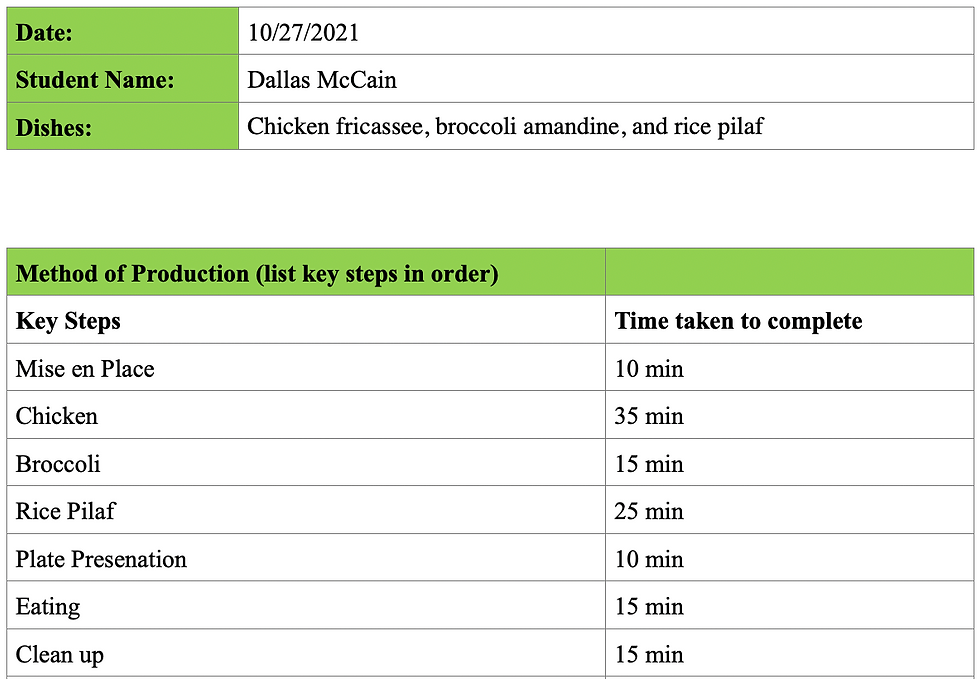
Plate Presentation


Citations
Alfaro, D. (2019, October 01). What does Amandine mean in cooking? Retrieved October 28, 2021, from https://www.thespruceeats.com/what-does-amandine-in-culinary-mean-995557#:~:text=In%20the%20culinary%20arts%2C%20the,in%20cuisines%20throughout%20the%20world.
Fricassee. (2021, July 11). Retrieved October 28, 2021, from https://en.wikipedia.org/wiki/Fricassee
History of pilaf - resource - smart kitchen: Online cooking school. (n.d.). Retrieved October 28, 2021, from https://www.smartkitchen.com/resources/history-of-pilaf
Labensky, S. R., Martel, P. A., & Hause, A. M. (681). On Cooking: A Textbook of Culinary Fundamentals, 6/e. Retrieved from https://platform.virdocs.com/r/s/0/doc/395669/sp/17708113/mi/59020164?cfi=%2F4%2F2%5BP7001015078000000000000000009CB0%5D%2F30%5BP7001015078000000000000000009DDC%5D%2F12%5BP7001015078000000000000000009E7A%5D%2F12%5BP7001015078000000000000000009E90%5D%2F8


Comments